
Most AI support tools learn your product from your help center. That works for how-to questions. It fails on the tickets that take the most time: something stopped working on one customer's site, and nobody knows why yet.
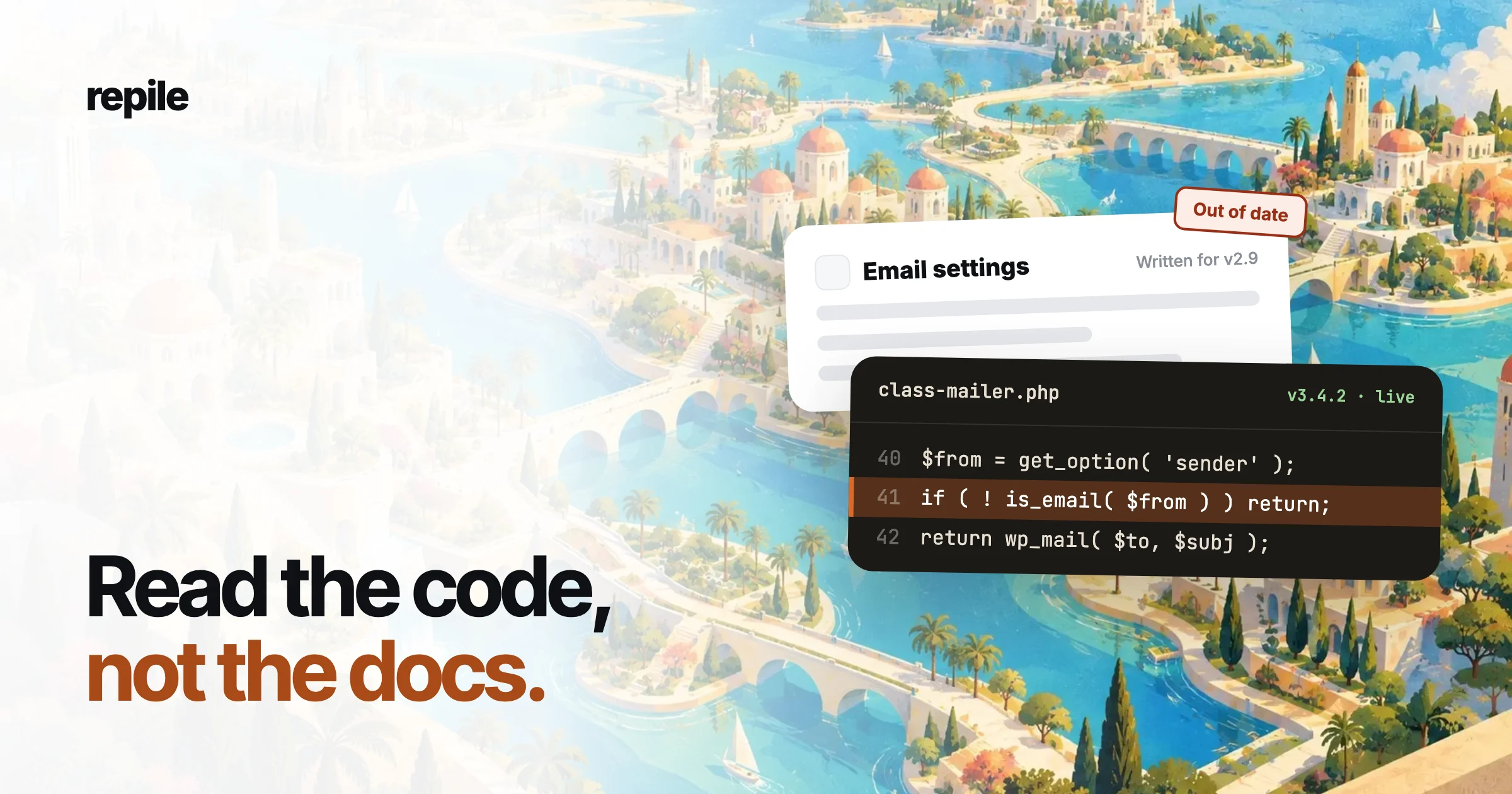
Docs go out of date. Code can't.
A help article is written once, for one version. Then you ship 3.1, 3.2 and 3.4, and nobody rewrites the "Email settings" article. A bot trained on that article answers questions about a plugin that no longer exists.
Your code has no such gap. It is the thing actually running on the customer's site. So Repile reads it directly from your GitHub repository.
The customer's version, not the latest one
A customer on 3.4.2 does not run your main branch. Repile checks out the release the customer has installed, so the code it reads is the code that failed.
This matters more than it sounds. A bug fixed last week still exists for everyone who has not updated, and a feature that only exists on main does not help them yet.
Answers with receipts
Every verdict points at the file and the line it came from. For example: class-mailer.php:41 skips every email when the sender setting is empty after an update.
That makes the answer easy to check. Your team does not have to trust the AI. They can open the line and see it.
It also says when it is not your bug
Reading the code works both ways. Often the plugin is fine and the cause is somewhere else: the customer's theme, another plugin, or their hosting. Repile says which, with the file and line for that too.
When it is your bug, Repile can open a GitHub issue with the steps to reproduce, the evidence and the failing line, linked back to the ticket.
Nothing to keep in sync
The best part is what you no longer do. Ship a release and Repile already knows it. There are no articles to rewrite and no bot to retrain.